Coordinators:
Ana Ferreira, Centro Interdisciplinar de Ciências Sociais, Universidade Nova de Lisboa
Nina Amelung, Instituto de Ciências Sociais, Universidade de Lisboa
Rafaela Granja, Centro de Estudos de Comunicação e Sociedade, Universidade do Minho
Contemporary societies are being reshaped by profound transformations in the production, circulation, legitimization and contestation of knowledge that unfold in a context marked by climate change crises, growing inequalities, geopolitical instability, health crises, the erosion of trust in institutions and expertise, and the rise of authoritarian and anti-democratic forces. These dynamics have brought questions surrounding expertise, misinformation, epistemic inequalities, digital power, surveillance, sustainability and participation have become central to understanding how futures can be imagined and built. In this context, if scientific knowledge and technology play an increasingly structuring role in societal organization, yet they are also sites of controversy, exclusion, resistance and political dispute.
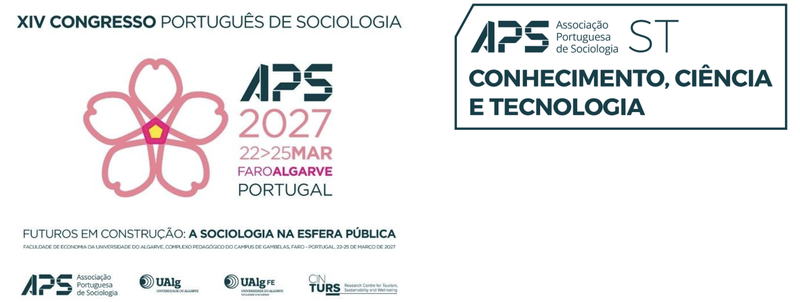
The Thematic Section Knowledge, Science and Technology of the Portuguese Association of Sociology invites contributions that critically examine how technoscientific developments both shape and are shaped by broader social, political and economic dynamics as well as the role of knowledge, science and technology in the construction of collective futures, paying particular attention to their implications for democracy, justice and social organization. We welcome contributions that explore both the risks associated with contemporary sociotechnical transformations and the possibilities they create for more inclusive, democratic and sustainable futures.
We invite the submission of abstract proposals based on academic and non-academic research, including empirical work, theoretical and methodological contributions, as well as reports of professional experiences.
Proposals, in addition to theoretical essays, must be formulated presenting their theoretical framework, objectives, methodologies used, results and conclusions.
Professional contributions can take the form of experience reports, including context, objectives, actors involved, methodologies, activities developed, and key learnings.
Proposals must be submitted via the personal area by the deadline specified in the submission guidelines.
Proposals may be submitted in Portuguese, English, Spanish or French.
The maximum length of the abstract is 2,500 characters (excluding spaces).
Evaluation will consider the clarity of objectives, methodological adequacy, relevance of results, and the overall quality of the proposal.
The Congress will take place in person at the Faculty of Economics of the University of Algarve, in Faro, from 23 to 25 March 2027, and may include online sessions on 22 March. At the time of submission, authors must indicate whether they intend to participate in person or online.
All the authors will be invited to submit the full papers for publication in the Congress Proceedings.
powered by eventQualia